 Adobe
 Sitecore
 Gradial
 PEGA
What Are Real Examples of Agentic AI in Business?
Oct 26, 2026 | 6 min read
TL;DR: Agentic AI has moved past demos. Companies now use AI agents to answer customer chats, book sales meetings, draft credit memos, and rewrite old code. The examples that work share four traits: clean access to data, one clear job, firm limits, and a person who owns the results.
Most talk about agentic AI sounds like a pitch deck. An agent will run your business while you sleep. Then you ask for a real example, and the room gets quiet.
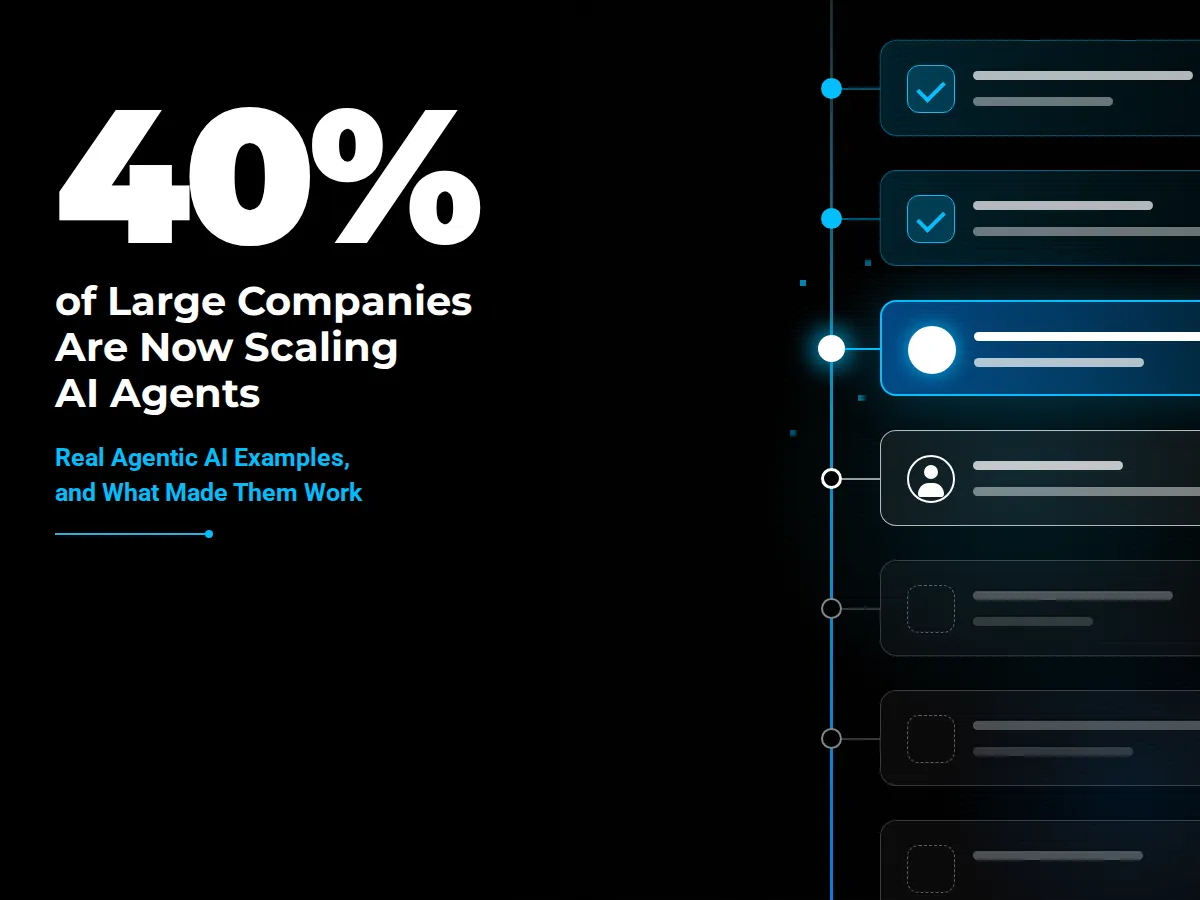
The real examples do exist, and they're growing. In McKinsey's 2026 State of AI survey, 40% of respondents at companies with more than $1 billion in revenue said they're now scaling AI agents. A year earlier, that number was 27%.
Below are examples from five parts of the business. Some went well. One shows what happens when a company moves too fast.
What makes an AI example "agentic"?
An AI example is agentic when the AI acts on its own to reach a goal. It plans the steps and carries them out in your systems.
A chatbot that explains your refund policy isn't agentic. An agent that looks up the order, checks the policy, issues the refund, and updates the customer record is.
What does agentic AI look like in customer service?
Customer service is where most companies start, because the work is high volume and the rules are clear. Gartner predicts that by 2029, agentic AI will resolve 80% of common customer service issues without a person stepping in.
Klarna, the payments company, offers a lesson on both sides. In early 2024, it launched an AI assistant that handled refund and payment questions in dozens of languages. Within a month, the assistant took on most of the company's customer chats. By May 2025, Klarna's CEO said the company would hire human agents again. The AI cost less, but the quality of service dropped. Customers needed a clear way to reach a person.
A good service agent knows when to stop. It should hand the chat to a person when a customer gets upset or asks for something outside the rules.
The lesson for everyone else: agents handle routine requests well, and people still need to own the hard cases.
What does agentic AI look like in sales and marketing?
In sales, agents take on the early, repetitive work, like answering first questions and booking meetings. McKinsey describes a U.S. homebuilder that trained AI sales agents on the company's past sales calls. The agents learned to talk like its top sellers, and a separate scoring agent checked each conversation against human results. According to McKinsey, the homebuilder's appointment rate rose sharply.
In marketing, agents build and adjust campaigns. They test versions of an ad, track results, and shift the budget toward what works. A person still approves the brand message and the spending limits.
What does agentic AI look like in finance and operations?
Finance teams use agents for document-heavy work. McKinsey worked with a retail bank on a credit memo agent. The agent pulled data from more than ten sources, drafted each section of the memo, and gave each section a confidence score. Low scores went to a human reviewer first. The bank ran it as a proof of concept, so the gains are still estimates.
Operations teams use agents to watch for problems. A market research firm built a group of agents that flags odd swings in its data and explains what caused them, such as a product recall or a storm that hit stores.
Accounts payable is a common next step. An agent can match invoices to purchase orders and flag the ones that don't line up, so the team only reviews the exceptions.
What does agentic AI look like in IT and software teams?
Software teams were early adopters, because code is easy to test. In July 2025, Goldman Sachs began testing Devin, an AI coding agent from the startup Cognition, with plans to roll it out across its tech teams. Coding agents fit well here because every change can run through the same tests and code reviews that a human engineer's work would.
Agents also help with old systems that no one wants to touch. McKinsey reports that a large bank used teams of agents to update a legacy core system. The agents documented the old code, wrote new code, and tested each feature. Human engineers supervised every step. The early teams cut their time and effort by more than 50%.
What does agentic AI look like in life sciences and healthcare?
Life sciences moves with more care because of strict rules on data and safety. Still, the shift has started at the top. In December 2025, the U.S. Food and Drug Administration (FDA) rolled out agentic AI tools for its own staff. The FDA said staff can use them for tasks like pre-market reviews and inspection prep. Use is voluntary, and the models don't train on the data companies submit.
For drug and device makers, common early jobs include drafting regulatory documents and checking promotional content against approved claims. In each case, a qualified person signs off before anything goes out.
Customer service, Klarna AI assistant: Handles refund and payment questions. Sign-off: Complex or unhappy customers go to a person.
Sales, U.S. homebuilder (McKinsey): Talks with leads and books appointments. Sign-off: A scoring agent and sales leaders review calls.
Finance, retail bank credit memos (McKinsey): Pulls data and drafts memo sections. Sign-off: Low-confidence sections go to a reviewer.
IT and software, large bank legacy system (McKinsey): Rewrites and tests old code. Sign-off: Engineers supervise each step.
Life sciences, FDA staff tools: Helps with reviews and inspection prep. Sign-off: Staff choose when to use it and own the decision.
Examples as reported through October 2026.
What did each example need to work?
The successful examples share four traits. None of them is about the AI model itself.
First, the agent could reach the right data. The credit memo agent needed more than ten sources. An agent with half the data writes half a memo. That's why the platform behind your agents matters. We covered how to pick one in our guide to choosing an enterprise AI platform.
Second, each agent had one clear job. The homebuilder didn't ask an agent to "do sales." It asked agents to book appointments.
Third, each agent had firm limits. Someone decided what it could do alone and what needed a sign-off.
Fourth, a person owned the results. When Klarna's service quality slipped, a human had to notice and change course. If you're ready to try this yourself, our step-by-step guide on how to deploy your first AI agent walks through the setup.
How do you spot your first agentic AI use case?
Look for work that happens often and follows clear rules. Then ask two questions. Can the agent reach the data the task needs? And can a person check the agent's work quickly?
If both answers are yes, you've found a strong first candidate.
Here's how that plays out. Say your finance team checks 500 vendor invoices a month against purchase orders. The data sits in your ERP, and a person can confirm a match in seconds. That's a good first job. Now compare that with approving new vendor contracts. The data is spread across email and legal files, and a mistake costs real money. Save that one for later.
For more on what's running in companies right now, see our look at AI agents in daily business operations.
Frequently asked questions
What is an example of agentic AI?
A customer service agent that looks up an order, checks the refund policy, issues the refund, and updates the record is agentic AI. It finishes the task by taking action across systems.
Are companies using AI agents in production today?
Yes. In McKinsey's 2026 survey, 40% of respondents at companies with more than $1 billion in revenue said they're scaling AI agents. Many others are still in pilots.
What are common AI agent use cases?
Common AI agent use cases include answering routine customer requests, booking sales meetings, drafting financial documents, flagging data problems, and updating old code. Most start with high-volume tasks that have clear rules.
Is agentic AI safe to use with customer data?
Agentic AI can be safe with customer data when you set it up with care. Give each agent only the access it needs, log what it does, and require a person's approval for sensitive actions like refunds or account changes.
Want help finding your first agentic AI use case?
CI offers a free end-of-year AI assessment. We'll review your workflows and systems, then point to the use case most likely to pay off first. Book your free AI assessment, or learn more about our AI services.
Author

Craig Taylor

Share this article


Subject Matter Expert

Craig Taylor
Practice Lead, CI Digital
Speak With Our Team
Share this article