 Adobe
 Sitecore
 Gradial
 PEGA
AI implementation for the enterprise: a roadmap from pilot to production
Oct 01, 2026 | 7 min read
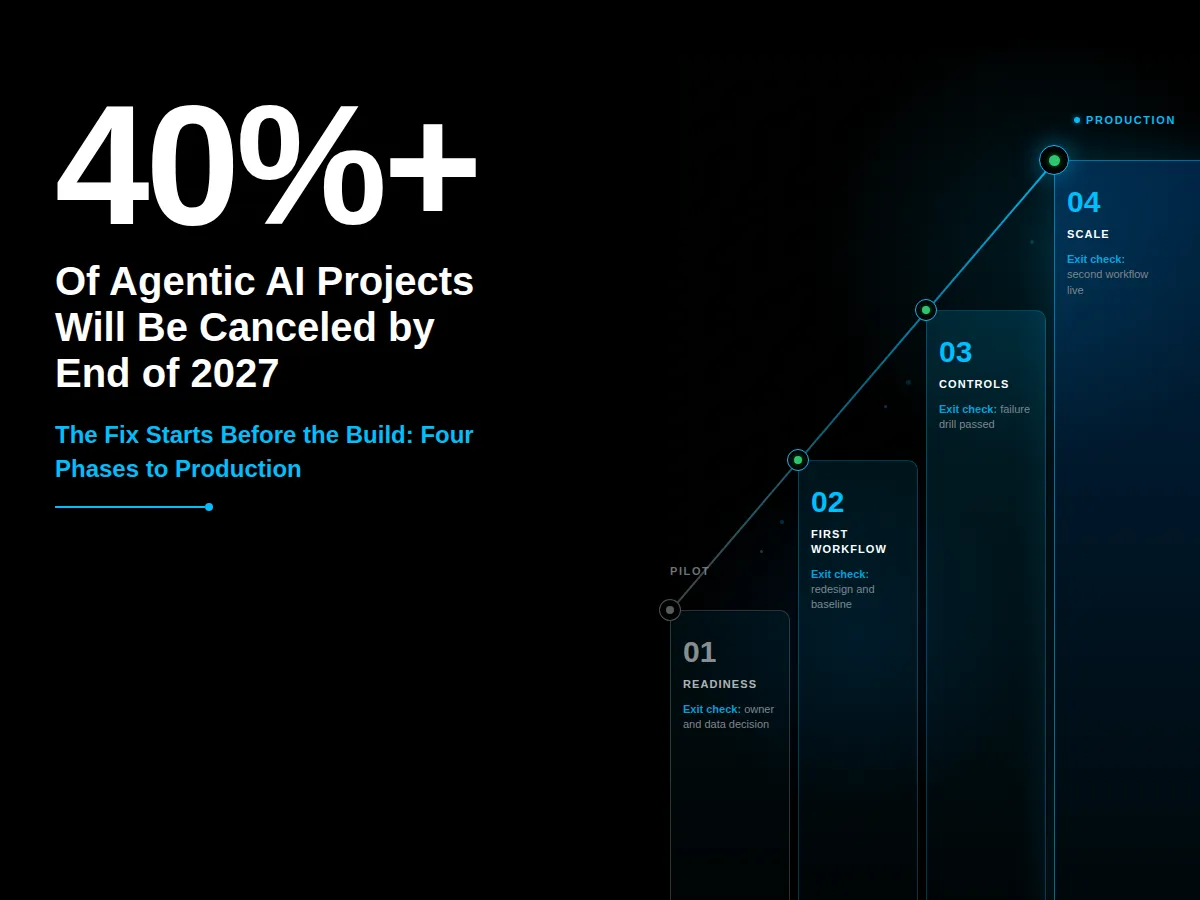
TL;DR: Enterprise AI projects often stall because teams skip decisions that have to come first, such as who owns the workflow and what the AI can touch. This roadmap runs in four phases: settle ownership and data access, redesign one workflow, add controls before go-live, and reuse those pieces to scale. Gartner expects companies to cancel more than 40% of agentic AI projects by the end of 2027, citing reasons that include unclear business value and inadequate risk controls.
Ask an enterprise team where its AI implementation stands, and you'll usually hear a tool name. The team licensed a model and ran a demo for leadership. Ask who owns the workflow that tool will change, and the answer takes longer.
That gap explains why many projects stall. The tool works. The work around the tool has no owner and no approval path. In a regulated company, that missing structure can stop a launch at the first compliance review.
This roadmap puts the decisions in order. It covers four phases and the check that closes each one. Use it whether you're planning your first workflow or your tenth.
What is AI implementation, and why does the order of steps matter?
AI implementation is the work of putting AI into a live business process, with an owner, approved data access, human review points, and a measure of success. A model in a demo isn't an implementation. A model that triages real requests, with someone accountable for the results, is.
Order matters because each step creates the inputs for the next one. You can't set review points for a workflow you haven't chosen, and you can't measure a workflow nobody owns. Gartner expects companies to cancel more than 40% of agentic AI projects by the end of 2027, citing reasons that include unclear business value and inadequate risk controls. (Gartner, June 2025) Those two reasons come down to decisions a team can make before it builds anything.
We covered what breaks once a pilot meets real volume in why AI pilots keep failing to scale. This post covers what to settle before and after that point.
What are the four phases of an enterprise AI roadmap?
An enterprise AI roadmap has four phases: readiness, first workflow, controls, and scale. Each phase ends with an exit check that decides whether you move on.
Phase 1, readiness: Who owns the work, and what data can the AI touch? Exit check: a named owner and a written data access decision.
Phase 2, first workflow: Which single workflow gives a clear before and after? Exit check: a redesigned workflow and a baseline measure.
Phase 3, controls: What can the AI do alone, and what needs a person? Exit check: controls in place and one failure drill passed.
Phase 4, scale: What can the next workflow reuse? Exit check: a second workflow live on the shared controls.
Phase 1: What should you settle before you build anything?
Start with ownership and data access. Name one person who answers for the workflow's results. Then write down which data the AI can read and which data stays off limits.
A readiness assessment puts those decisions on paper. It also surfaces gaps that would stall a launch later, like a system with no API or a data set nobody has approved for AI use. We cover why data and process clarity come first in building the agentic enterprise.
Exit check: a named owner and a written data access decision. If you can't produce both, you aren't ready to build. Learning that in week two beats learning it in month six.
Phase 2: How do you choose and redesign the first workflow?
Pick one workflow that runs often and produces a measurable output. Check that it follows clear rules, even if exceptions are common. Avoid any workflow where one wrong output reaches a patient or a regulator without review. Start where a person already checks the work.
Then redesign the workflow instead of adding AI to the current version. McKinsey's 2025 State of AI survey found that AI high performers, about 6% of respondents, were nearly three times as likely as others to have fundamentally redesigned individual workflows. (McKinsey, November 2025) Redesign means deciding which steps the AI takes and which steps a person keeps, then defining the handoff between them.
Before launch, record a baseline: how long the workflow takes today and how often it errs. Without a baseline, you can't prove a gain. Our post on how to know if your AI implementation is working walks through the measures.
Exit check: a redesigned workflow and a baseline measure.
Phase 3: What controls does a regulated team need before go-live?
A regulated team needs four controls before an AI workflow touches real work: human review points, an audit log, access limits, and a rollback path.
Review points decide what the AI can finish alone and what a person must approve. Set them by risk, not by convenience. The audit log records what the AI saw and produced, and who approved it, so you can answer a regulator's question months later. Access limits keep the AI inside the data you approved in phase one. A rollback path lets you switch the workflow back to manual work the same day if something goes wrong.
Build these controls before launch. Retrofitting them after an incident costs more and tends to pause the whole program.
Exit check: controls tested, not just documented. Run one failure drill. Feed the workflow a bad input, then confirm that a person catches it and the log shows what happened.
Phase 4: How do you scale beyond one workflow?
Scale by reuse. The second workflow should reuse the first one's controls and data access rules instead of rebuilding them. That reuse turns a pilot into production. A pilot proves one workflow works. Production means the workflow has an owner and ongoing monitoring, and the next workflow starts faster because the groundwork exists.
Scale is where many teams stall. McKinsey's survey found that only one-third of respondents said their organizations were scaling AI across the enterprise. We walk through the regulated version of this step in what it actually takes to scale AI in life sciences.
Exit check: a second workflow live on the shared controls.
Where should an enterprise start this quarter?
Start with a working session, not a platform decision. List five candidate workflows. Score each one for volume and for how easily you can measure it. Pick one. Name its owner and write the data access decision. Those steps put phase one's exit check within reach.
If you'd rather not run that session alone, CI starts with an AI readiness assessment and works with your team from there. Talk to CI about where your AI implementation stands.
Frequently asked questions
What is AI implementation?
AI implementation is the work of putting AI into a live business process, with an owner, approved data access, human review points, and a measure of success. It differs from a pilot because someone is accountable for the results.
What are the steps in an enterprise AI implementation?
An enterprise AI implementation has four phases: readiness, first workflow, controls, and scale. Readiness settles ownership and data access. The first workflow phase redesigns one process and records a baseline. The controls phase adds human review, an audit log, access limits, and a rollback path. The scale phase reuses those pieces for the next workflow.
Why do enterprise AI implementations stall before production?
Teams skip decisions that have to come first, such as who owns the workflow and what data the AI can use. Gartner expects companies to cancel more than 40% of agentic AI projects by the end of 2027, citing reasons that include unclear business value and inadequate risk controls.
What does an AI readiness assessment cover?
An AI readiness assessment reviews who owns candidate workflows, what data the AI can access, which workflows suit a first build, and what controls a regulated team needs before launch. It typically ends with a short list of workflows and the gaps to close first. CI offers one as the first step.
Author

Craig Taylor

Share this article


Subject Matter Expert

Craig Taylor
Practice Lead, CI Digital
Speak With Our Team
Share this article