 Adobe
Adobe  Sitecore
  Gradial
  PEGA
PEGA Do More with Less: The Cost-Efficient Power of AIaaS
Apr 28, 2026 | 3 min
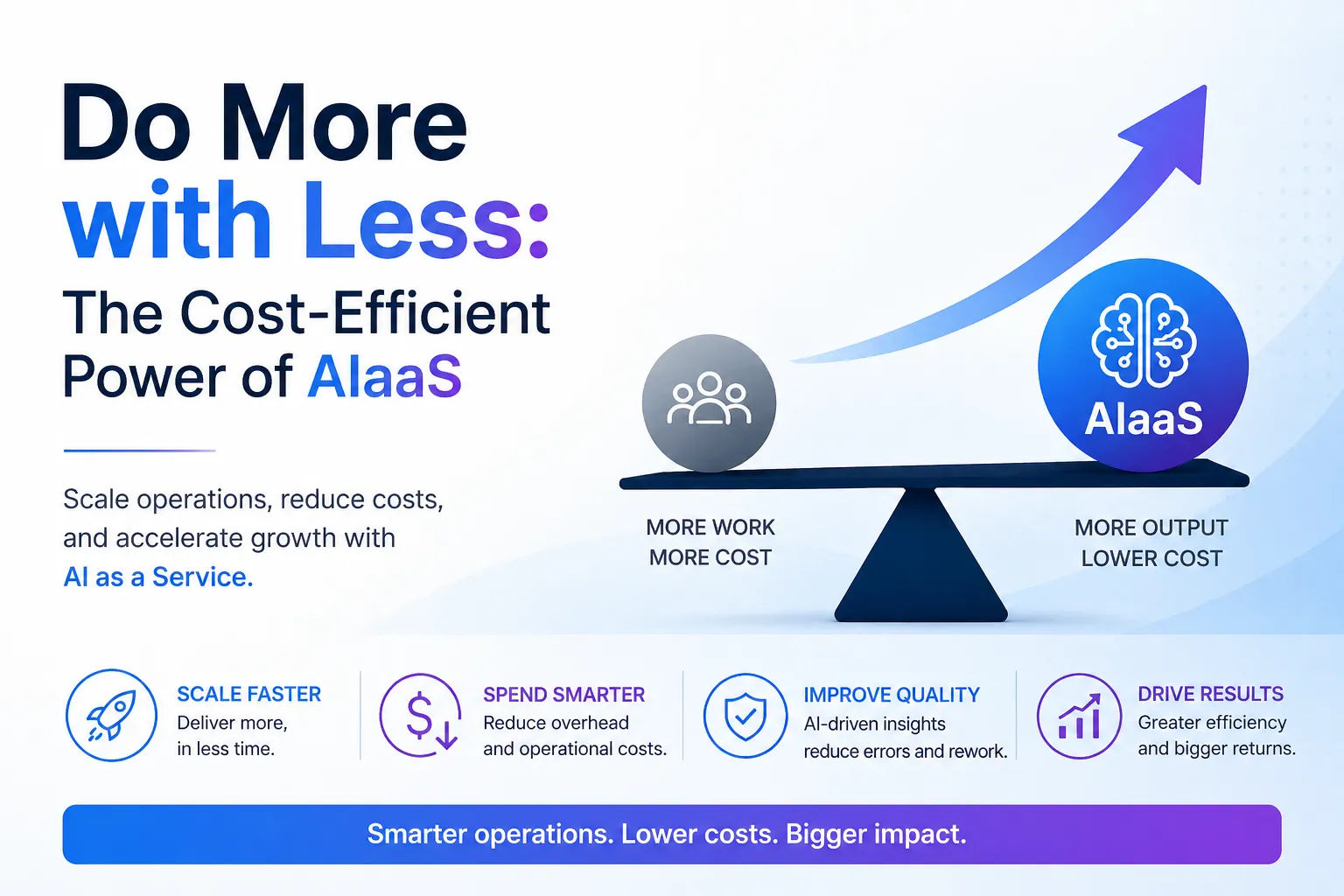
Scaling operations has always come with a trade-off.
Want to grow faster? Hire more people.
Need to deliver more? Increase budget.
Trying to improve output? Expand infrastructure.
For years, scaling meant adding cost in lockstep with growth.
But AI as a Service (AIaaS) changes that equation entirely.
The Scaling Problem: Growth Comes at a Cost
Traditional scaling models are inherently linear:
- More demand → more headcount
- More projects → more overhead
- More complexity → more management layers
Even the most optimized organizations eventually hit friction:
- Rising labor costs
- Slower onboarding cycles
- Operational inefficiencies
At a certain point, growth becomes expensive—and harder to sustain.
AIaaS: Breaking the Cost Curve
AIaaS introduces a fundamentally different model:
Scale output without proportionally scaling cost
Instead of relying solely on human effort, AIaaS leverages:
- AI agents to execute repetitive and process-driven work
- Automation frameworks to streamline workflows
- Human oversight to guide, refine, and optimize
The result is a non-linear scaling model, where:
- Output increases significantly
- Costs grow marginally (if at all)
Cost Efficiency at Every Layer
AIaaS doesn’t just reduce costs in one area—it optimizes across the entire operational stack.
1. Labor Efficiency
AI handles execution-heavy tasks, allowing smaller teams to produce more.
In modern engineering environments, AI-assisted development is already accelerating delivery cycles and improving throughput without increasing team size .
2. Operational Overhead
Fewer manual processes mean:
- Less coordination overhead
- Fewer bottlenecks
- Reduced management complexity
3. Quality & Rework Reduction
AI-driven testing and validation reduce costly errors and rework by identifying issues earlier in the lifecycle .
4. Speed-Driven Savings
Faster delivery means:
- Lower cost per project
- Faster realization of value
- Reduced opportunity cost
Scaling Without the Growing Pains
One of the biggest advantages of AIaaS is frictionless scalability.
Traditional scaling introduces challenges like:
- Hiring delays
- Training time
- Cultural alignment
- Knowledge gaps
AIaaS minimizes these issues by:
- Providing instantly scalable capacity
- Standardizing execution across workflows
- Maintaining consistency regardless of scale
Even Agile delivery functions are evolving with AI—using intelligent insights to improve predictability, identify risks, and maintain flow across teams .
If your organization is trying to scale without ballooning costs, it’s time to rethink the model.
AIaaS offers a path to grow faster, operate leaner, and deliver more—without the traditional trade-offs.
Let’s connect to explore how AIaaS can help you scale more efficiently.
Whether you're optimizing current operations or planning for growth, there are immediate opportunities to unlock value.
From Headcount Scaling to Capability Scaling
The real shift with AIaaS is this:
You’re no longer scaling people—you’re scaling capability.
Instead of asking:
- “How many people do we need?”
You start asking:
- “How much can we automate?”
- “Where can AI increase throughput?”
- “How do we maximize output per resource?”
This mindset shift is what drives long-term cost efficiency.
The Compounding Effect of AIaaS
AIaaS doesn’t just create one-time savings—it compounds over time.
As AI systems learn and improve:
- Processes become more efficient
- Insights become more accurate
- Execution becomes faster
This creates a flywheel effect:
- Faster delivery
- Lower cost per output
- Increased capacity
- More opportunities for growth
And the cycle continues.
Measuring Cost-Effective Scale
To truly evaluate AIaaS, organizations should look at:
- Cost per unit of output (not just total cost)
- Throughput per team member
- Time-to-value for new initiatives
- Reduction in manual effort and rework
These metrics tell the real story—and they consistently point to one conclusion:
AIaaS delivers more value at a lower marginal cost.
The Bottom Line
AIaaS is the most cost-effective way to scale because it:
- Breaks the link between growth and headcount
- Reduces operational overhead
- Accelerates delivery and value realization
- Improves quality and consistency
It enables organizations to grow smarter, not just bigger.
The organizations that scale most efficiently in the next decade won’t be the ones with the largest teams—they’ll be the ones that leverage AI most effectively.
If you're ready to scale operations without scaling costs, let’s talk.
We can walk through your current environment, identify high-impact opportunities, and build a roadmap to help you grow faster with AIaaS.
The sooner you start, the more cost advantage you create.
Author

Tom Boller Jr.

Sales Director - Digital
Share this article


Speak With Our Team
Share this article