 Adobe
Adobe  Sitecore
  Gradial
  PEGA
PEGA How Do You Know If Your Team Actually Needs AI Help?
Dec 23, 2025 | 4 min read
How Do You Know If Your Team Actually Needs AI Help?
Most teams do not need “more AI.” They need to actually solve their problems and produce better outcomes.
That path is what we mean by workforce maturity.
In this post, I will share a practical POV on workforce maturity, the five levels most teams move through, and the signals that tell you when it is time to level up. At the end, I will share how CI Digital helps teams make the jump safely and sustainably.
Quick answer
You probably need AI help if your team is stuck doing repeatable work by hand, approvals pile up, and quality drops when speed matters. Workforce maturity is the step by step path from manual work to automated work, with humans staying in control where it counts.
Workforce maturity in plain English
Workforce maturity is simply: how your team gets work done today, and a roadmap to you get you where your human workforce is seamlessly integrated with a digital workforce
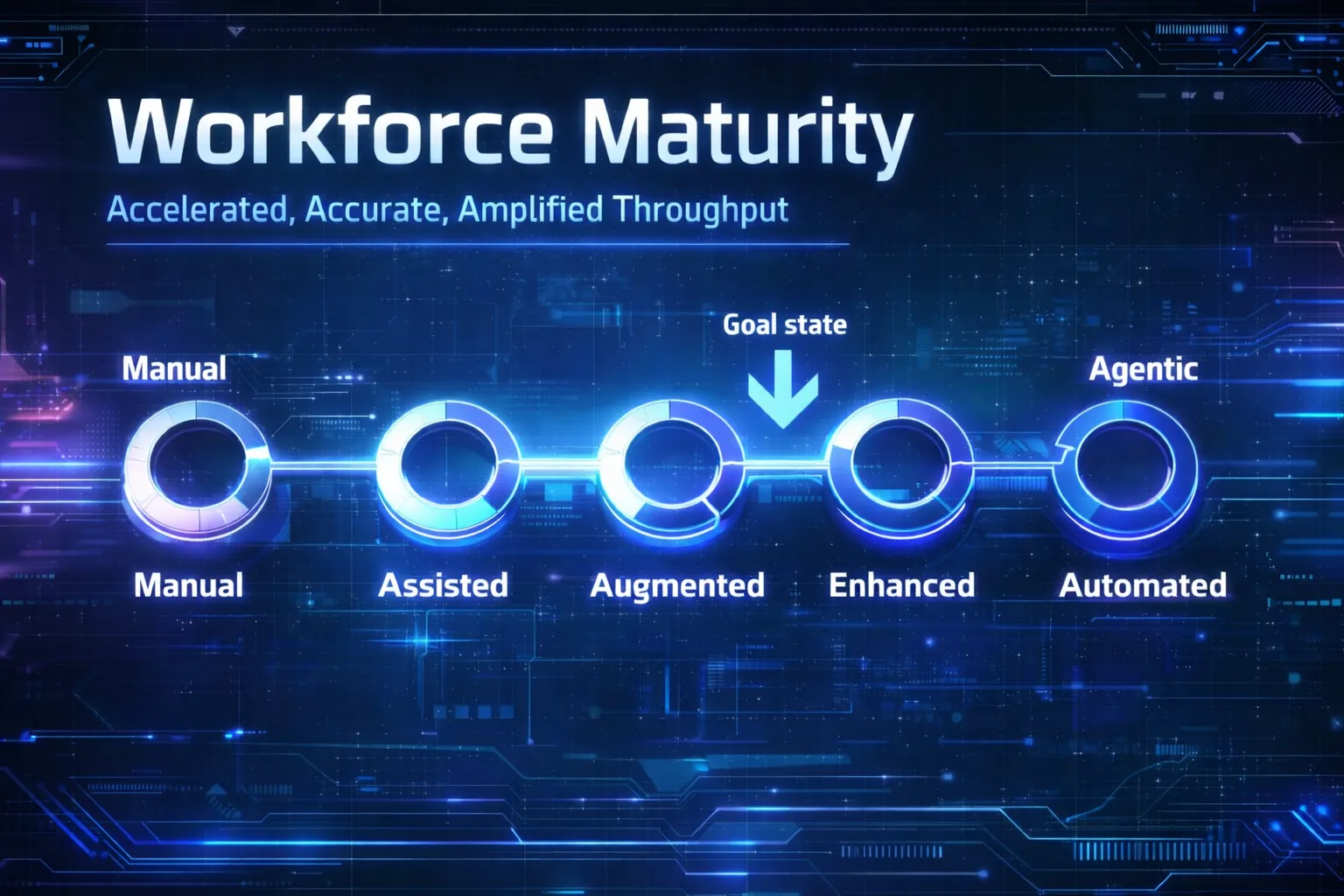
From an “agentic workforce” view, maturity often moves through five stages: Manual → Assisted → Augmented → Enhanced → Automated. Each stage represents a real shift in how work flows, how reliable outcomes are, and how much capacity your team gets back.
The five stages of workforce maturity
1) Manual
All work is done through manual effort. This is where teams live in spreadsheets, tickets, copy paste, and endless handoffs.
2) Assisted
Teams use hand-crafted prompts to generate work. This is the “prompt phase.” Helpful, but still fragile and inconsistent across people.
You will see a small boost in daily output and better first drafts, but results still depend on who wrote the prompt. Progress is real, but it is not repeatable yet.
3) Augmented
Agents pick up simple tasks. You start to see repeatable help, like routing, tagging, drafts, basic QA checks, and first pass summaries.
With simple tasks handled by agents, your team gets time back to tackle higher value work. Output becomes more predictable because repeatable tasks start running the same way every time.
4) Enhanced
Work is significantly enhanced because agents unlock capacity. This is the turning point. People stop being human middleware and start doing higher value work.
This is where capacity jumps. Most routine work is now steady and forecastable, so the team can focus on improving workflows, reducing friction, and scaling what works.
5) Automated
All low impact, low value work is automated. Humans stay in the loop for exceptions, approvals, judgment calls, and strategy.
This is the ideal scenario goal that is “Long term” in nature.
How to tell what stage you are in
Here are common signs, by stage, that show where a team truly sits.
If you are in Manual
- Work is blocked by handoffs and “who owns this” confusion
- People are doing the same checks, the same tagging, the same formatting
- Quality depends on the person, not the process
- Launch speed is limited by how fast people can move, not by tools
If you are in Assisted
- Prompts help, but every person has their own “secret sauce”
- You still have to manually paste outputs into systems
- Errors slip in because the process is not enforced
- The team spends time rewriting AI output more than using it
- The output is different based on who is doing the prompting, thus the results will vary.
If you are in Augmented
- Work speeds up, and you start seeing exactly where the remaining friction lives
- AI handles the easy steps, so your team can focus on fixing the hard steps
- Reviews get more focused as risk starts showing up in the right places
- You are building momentum you can repeat, which sets you up to scale across the org
- This is your initial goal.
If you are in Enhanced
- AI removes busywork and your best people get time back
- Work moves with fewer meetings and fewer follow ups
- Quality improves because standards are applied more consistently
- You can scale output without scaling stress
If you are in Automated
- Low value steps happen by default, with logging and controls
- Humans spend time on decisions, not on pushing buttons
- Exceptions are visible, not hidden
- Your throughput rises without sacrificing governance
- Being a truly "Automated" workplace is a long term goal. Currently, proper automation takes resources that is only available to the amazons and googles of the world.
The “AI help” test: 7 signals decision makers should watch
If you are a marketing ops leader, these are the signals that matter most. If you see 3 or more, you are likely ready for the next maturity stage.
- Your backlog never shrinks
You ship, but the queue stays full. - Approvals are your bottleneck
Not because reviewers are slow, but because everyone is using their own individual prompts and doing things differently, so the output quality will vary. - You cannot scale without hiring
More work equals more headcount, every time. - Your martech stack is underused
You own powerful platforms, but you don’t have the capacity to use every feature. - Your best people do low value work
Smart operators spend time on formatting, routing, and checking instead of improving the system. - Quality drops when speed matters
Every rush job creates cleanup and rework. - You lack controls and visibility
You cannot easily prove what happened, when, and why.
What “agentic” looks like when it is real
A useful way to picture agentic work is a network of agents that acts like an extension of your operations team, automating repeatable workflows, integrating with your process, and keeping human controls in place.
In regulated environments like market access, agents are often designed to do practical work like monitoring sources, detecting changes, updating documents, creating summaries, and keeping playbooks current. The point is not the exact use case. The point is the pattern: agents take repeatable work, keep it current, and free people to focus on decisions and relationships.
That same pattern applies in marketing operations:
- Monitoring and summarizing performance changes
- Drafting variants with guardrails
- Logging edits, routing work, and enforcing steps
- Surfacing risk areas so humans review what matters
If you want a quick outside-in view of where your team sits today and what to fix first, you can talk with CI Digital and we will help you map a maturity path that fits your workflows.
A simple maturity ladder you can use in a meeting
Here is a clean way to explain the maturity path to stakeholders:
- Manual: People do the work
- Assisted: People ask AI for help
- Augmented: AI agents do small tasks
- Enhanced: AI agents unlock capacity across the workflow
- Automated: Low value work runs by default, with controls
If your team is stuck between Assisted and Augmented, that is normal. Many teams stall there because prompts feel productive, but workflows do not actually change.
The biggest mistake to avoid
The biggest mistake teams make is trying to jump from Manual straight to Automated.
Gartner predicts 30% of GenAI projects will be abandoned after proof of concept by the end of 2025 because many teams try to jump from no automation to full automation without building the skills, data quality, and controls first. It's like expecting a brand-new chess player to become a grandmaster overnight.
Instead, treat maturity like a rollout:
- Discovery (2 to 4 weeks): document the workflow, take a baseline, set the goal
- Training and configuration (4 to 12 weeks): configure tools, train models to high accuracy, run human guided testing
- Rollout and enhancements: launch, tune, then expand to more workflows
This phased approach is how you protect quality and keep trust.
How CI Digital helps teams move up the maturity ladder
Once a reader sees the maturity path, the next question is simple: “How do we move up without breaking our workflow?”
CI Digital’s Agentic Marketing Operations services are designed to help teams progress through maturity in a controlled way:
- Start with discovery and baseline measurement
- Build agentic workflows with human in the loop controls
- Train and configure toward high accuracy before scaling
- Roll out in phases so you get value quickly without chaos
If you want the foundation behind this model, read What Is Agentic Marketing Operations?
If your team is buried in manual work, stuck in review cycles, or unable to scale output without more headcount, you do not need more tools. You need a maturity plan and an operating model that changes how work gets done. If you want help building that plan, connect with CI Digital here.
Author

Marcus Calero

Marketing Content Manager
Share this article


Subject Matter Expert

Mike Shaw
Managing Partner, Ciberspring
We bridge the gap between technology and marketing for our clients.
Speak With Our Team
Share this article