
 Adobe
Adobe  Sitecore
  Gradial
  PEGA
PEGA Pharma market access data: the difference between a reporting system and an activation system
Jul 15, 2026 | 8 min read
Ask a market access team if their data is good, and most will say yes without hesitation. They have dashboards. They have quarterly reports. Coverage, formulary tier, prior authorization rates, all tracked and presented cleanly in a business review.
The better question is: good for what? Data that's good enough to explain what happened last quarter is a different thing entirely from data that's good enough to change what happens this week. Most market access teams have the first kind. Very few have built the second.
What does “good data” actually mean for a market access team?
It depends what you're trying to do with it. If the goal is historical reporting, then clean dashboards and accurate quarterly summaries are enough. If the goal is to respond to a payer decision in the same week it happens, the bar is completely different.
The real test is whether the data can connect payer, plan, formulary, provider, geography, and prescribing behavior in one model, and whether it can tell you fast enough to matter when coverage changes. Can field teams act on the insight, or does it stay in a dashboard until someone builds a slide about it next quarter? Do you know which source provided each data point well enough to trust it in a live workflow? Market access data is only good if it's timely, connected, governed, and actionable. If it can't change what someone does today, it's not intelligence. It's reporting.
What's the architectural difference between a reporting system and an activation system?
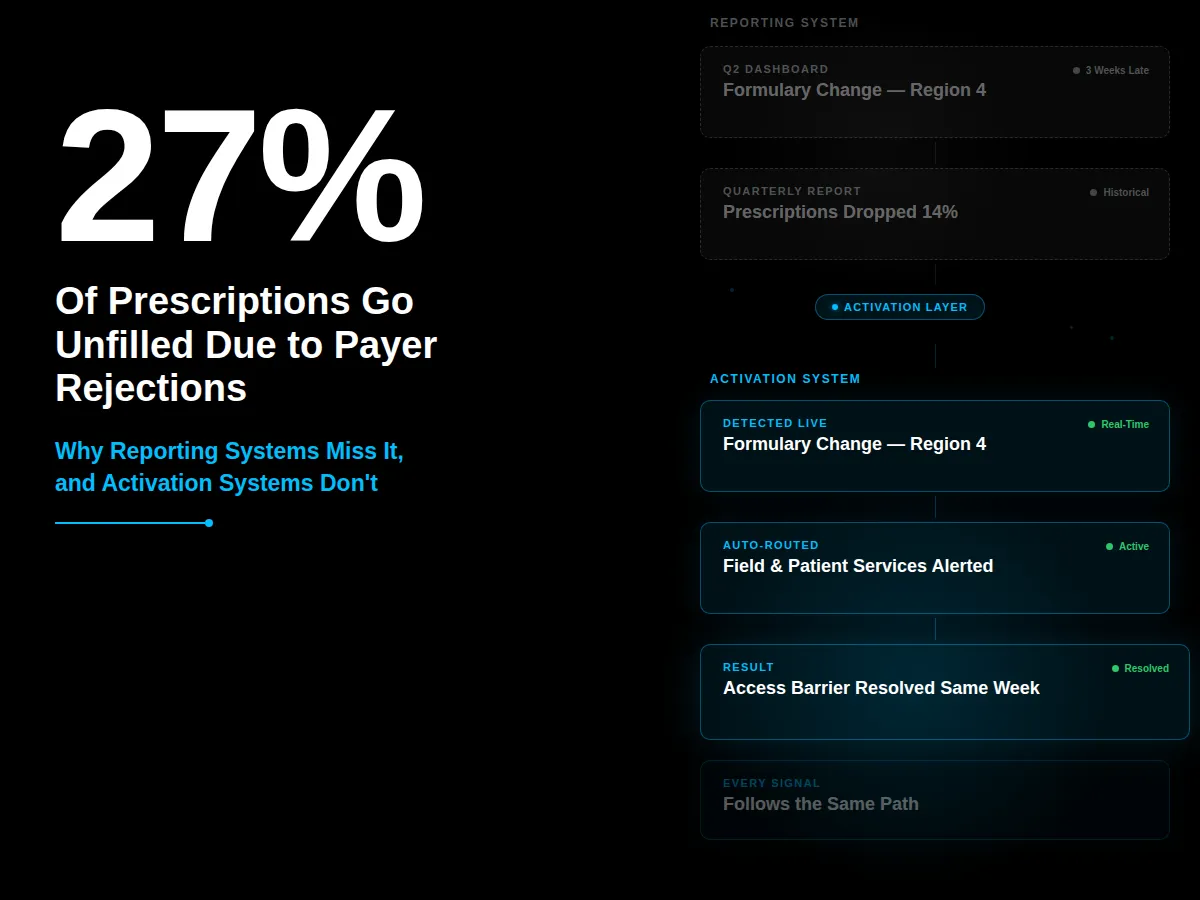
A reporting system looks backward. It aggregates what already happened, builds dashboards, and helps a team analyze historical performance. That's a legitimate function. It's just not the same function as responding to something in real time.
An activation system listens for a signal and triggers a response. Architecturally, that requires event-driven integration, a unified data model, identity resolution, segmentation, workflow automation, and activation pathways into CRM, service, field, patient support, and analytics tools. The reporting system and the activation system can use the same underlying data. The difference is what happens the moment something changes.
What happens when a formulary changes, in each type of system?
In a reporting system, a formulary change shows up as a data point. Prescriptions dropped in a region. Someone notices it in next month's dashboard, traces it back to a payer decision, and writes a summary explaining what happened. By the time that summary reaches anyone who could act on it, the quarter is usually over.
In an activation system, the same formulary change gets detected as it happens. The system identifies which providers and patients are affected, updates segmentation, alerts the field teams who need to know, informs patient services so they can prepare for a spike in prior authorization requests, and triggers whatever approved next steps apply. The shift is from “we saw the problem last quarter” to “we detected the signal and coordinated a response.”
The cost of not making that shift is measurable. IQVIA's Institute for Human Data Science found that 27% of written prescriptions in the U.S. go unfilled due to payer rejections and patient abandonment, with the unfilled rate reaching 34% in Medicaid and 28% in commercial insurance. (IQVIA Institute, 2025) A meaningful share of those rejections trace back to formulary and prior authorization issues that a faster, better-coordinated response could catch earlier in the process, before the patient gives up on filling the prescription at all.
What does Salesforce Data Cloud add at the activation layer?
Data Cloud is built to connect the signals that historically lived in separate systems: claims data, CRM interactions, payer and plan data, patient access cases, benefit investigation outcomes, and prescribing trends. On its own, none of those signals is dramatic. Connected, they become operational intelligence.
Once formulary and payer data flow through a unified model, an AI agent or a rules-based workflow can identify which HCPs are likely affected by an access change, prepare patient services for an expected increase in benefit investigation volume, route field teams to the right accounts with approved messaging, and let market access monitor whether the response actually moved the access outcome. This is the same foundation that makes AI use cases in pharma CRM reliable in the first place: an agent recommending a next step is only useful if the data behind that recommendation is current and connected.
How does this compare to a traditional BI dashboard approach?
A BI dashboard is a reporting tool by design. It's built to visualize what already happened, and it does that well. What it doesn't do natively is trigger a workflow, update a CRM record, or notify a field rep the moment a payer decision lands. That gap isn't a limitation of the dashboard. It's just a different job than the one a dashboard is built for.
Activation requires the data layer to sit closer to the operational systems where work actually happens, which is part of why platform choice matters when a pharma organization is deciding how commercial, medical, and market access teams should be connected. A dashboard sitting next to the workflow isn't the same as a data layer built into it.
What's the biggest mistake teams make trying to fix this?
The most common mistake is trying to solve an intelligence problem with a dashboard project. If the underlying data model is fragmented, a new dashboard just makes the fragmentation more visible. The charts might look better. The relationships between payer, provider, patient, plan, product, and geography are still untrustworthy underneath them.
Market access intelligence requires a connected data foundation first: common identifiers across systems, clean payer and plan hierarchies, source governance, and defined rules for how data gets joined and interpreted when sources disagree. Without that foundation, teams spend their time debating whose numbers are right instead of acting on what the numbers say. That foundation is the same data model layer CI Digital's framework for a connected pharma enterprise addresses across HCP, enrollment, and market access data alike.
Where should a market access team start?
Start with one signal that already causes visible pain: a formulary change, a prior authorization spike, or a specific payer's coverage decision that historically triggers a scramble. Map exactly how that signal currently gets detected, who finds out about it, and how long it takes before anyone acts. In most organizations, the answer is measured in weeks, not hours.
From there, build the activation path for that one signal before expanding to others. Connect the data sources involved, define who needs to be alerted, and automate the handoff to field, medical, or patient services. A working example on one signal builds the case for expanding the same pattern across the rest of market access intelligence.
CI Digital builds market access activation architectures on Salesforce Data Cloud for pharma teams working through exactly this gap. Talk to our Salesforce team about which signal to activate first.
Frequently asked questions
What is the difference between market access reporting and market access activation?
Market access reporting aggregates historical data into dashboards that explain what already happened: coverage trends, formulary tier changes, or prescribing patterns from a prior period. Market access activation detects a signal as it happens, such as a formulary change or a payer decision, and triggers a coordinated response across field, medical, and patient services teams in near real time. Reporting explains the past. Activation changes what happens next.
How does Salesforce Data Cloud support market access intelligence in pharma?
Salesforce Data Cloud connects claims data, CRM interactions, payer and plan data, and prescribing trends into a unified model, then makes that connected data available for segmentation, AI-driven recommendations, and workflow automation. Instead of each data source living in its own silo, Data Cloud lets a formulary change or access barrier trigger an activation pathway into the systems where field, medical, and patient services teams actually work.
Why do formulary changes catch pharma commercial teams off guard?
Because most market access data systems are built for reporting, not detection. A formulary change typically surfaces in a dashboard after prescriptions have already dropped, weeks after the decision took effect. Without event-driven data architecture that flags the change as it happens, teams find out about the impact only after it has already affected patients and revenue.
What data foundation does market access intelligence require before activation is possible?
It requires common identifiers across payer, plan, provider, and patient records, clean formulary and payer hierarchies, defined source governance, and rules for how conflicting data gets resolved. Without that foundation, adding dashboards or AI tools on top of fragmented data just makes the fragmentation more visible without making the data any more trustworthy or actionable.
Author

Jeff Sumption

Share this article


Subject Matter Expert
Jeff Sumption
Salesforce Solution Architect
Speak With Our Team
Share this article