 Adobe
Adobe  Sitecore
  Gradial
  PEGA
PEGA Your Company Has an AI Policy. Here’s Why That’s Not Enough.
Apr 17, 2026 | 5 min read
Series: The AI Governance Series — Blog 1 of 4
TL;DR — Key Takeaways
- An AI acceptable use policy is a document. Enforcement is what keeps people accountable.
- Most companies have written rules about AI. Almost none have real-time enforcement.
- The gap between AI policy and AI governance is where data leaks and compliance failures happen.
- Shadow AI — employees using unsanctioned tools — thrives in organizations with policy but no oversight.
- Real enforcement means monitoring behavior as it happens, not reviewing incidents after the fact.
- This post is the starting point for a four-part series on building real AI governance.
You drafted the policy. Legal reviewed it. HR sent it out. Everyone signed. You’re done, right?
That’s how most companies approach AI governance. They write rules, circulate them, and move on. The problem is that a written policy does exactly nothing to stop an employee from pasting customer data into ChatGPT on a Tuesday afternoon.
AI acceptable use policy enforcement — actually watching how AI gets used and acting on violations — is the missing layer in almost every organization we talk to. The policy exists. The enforcement doesn’t.
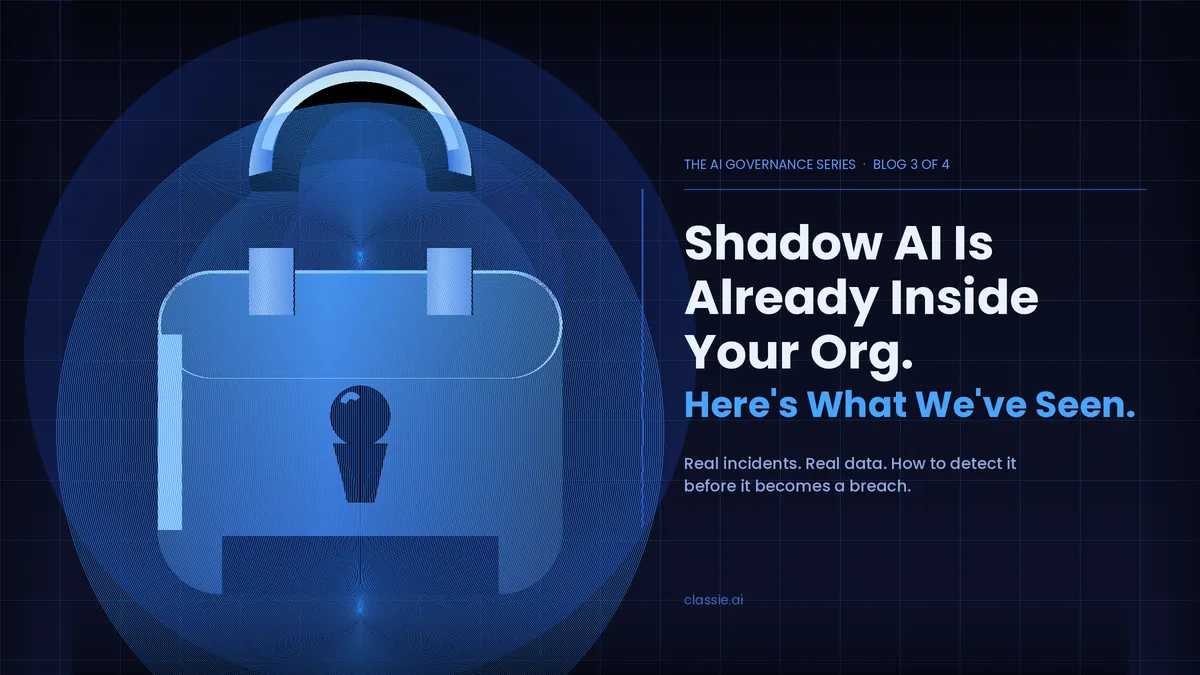
This is the first post in a four-part series on building AI governance that works in the real world. We’ll cover the questions your security team should already be asking, what shadow AI looks like when it shows up inside your organization, and what happens to your data after you deploy Microsoft Copilot.
What is the difference between an AI policy and AI governance?
An AI policy is a set of written rules. AI governance is the system that makes sure those rules get followed. The two are not the same thing, and confusing them is the fastest way to end up with a false sense of security.
Think of it like a speed limit. The sign on the road is the policy. The speed camera is governance. Without the camera, the sign is just a suggestion. Most companies right now have posted the sign and are hoping for the best.
AI policy tells employees what they should and shouldn’t do. Governance — real governance — means your organization can see what is actually happening, detect when someone steps outside the approved boundaries, and respond before it turns into an incident.
A policy document in a shared drive does not stop anyone from doing anything. You need visibility into what your AI tools are actually doing with your data before you can call it governance.
Why doesn’t an AI acceptable use policy prevent misuse on its own?
Because policies rely on self-enforcement. They assume people will remember the rules, apply good judgment every time, and self-report when they make a mistake. None of those assumptions hold up consistently at scale.
The data backs this up. 83% of organizations plan to deploy AI agents this year, but only 31% feel equipped to secure them. That gap is not a training problem. It’s a visibility problem.
Employees are not malicious. Most AI misuse isn’t intentional. Someone is trying to get a report done faster and doesn’t stop to think about what data they just handed to an external AI tool. A policy in a document can’t catch that in real time. Only enforcement can.
Not sure where your governance gaps are? CI can help you find out.
→ Talk to CI about your current AI governance posture
How do you actually enforce an AI acceptable use policy at work?
Real-time enforcement means your security tools can see AI activity as it happens — which prompts are being submitted, which files are being touched, which external tools are being used — and flag or block behavior that violates policy.
This is different from reviewing logs after something goes wrong. It’s also different from blocking AI tools outright, which just pushes employees toward workarounds you can’t see at all.
Platforms like Classie’s real-time enforcement capabilities are built specifically for this problem. They sit between your employees and the AI tools they use, capturing context — not just activity logs, but intent, document access, and policy impact — and surfacing violations before they become incidents.
The enforcement layer needs to do three things well: discover what AI tools are actually in use across your organization (including the ones IT doesn’t know about), analyze behavior against your policies in context, and give you the ability to act on what you find.
Most organizations are surprised by how many AI tools are already running inside their environment when they actually look. Shadow activity doesn’t wait for the governance program to catch up
What is shadow AI and why does it matter for policy enforcement?
Shadow AI refers to AI tools employees use without official approval — usually because the sanctioned tools don’t do what they need, or because the approval process is too slow. It is the AI equivalent of shadow IT, and it is already inside most enterprises.
Gartner projects that 40% or more of agentic AI projects will fail or be canceled due to inadequate risk controls through 2027. A big driver of that is unsanctioned usage that no one is tracking.
If your AI acceptable use policy doesn’t account for the tools employees are using outside the approved list, you have a gap. And that gap is often where your most sensitive data ends up.
Want to see what real AI enforcement looks like in practice? Join our upcoming webinar to see it live. **→ ** Save your seat
What does strong AI governance look like in practice?
It starts with a live inventory. You need to know what AI tools are running in your environment — not based on what was approved, but based on what is actually being used. That inventory has to update automatically, because new tools appear faster than any manual review process can keep up.
From there, governance means behavioral analysis. Each AI interaction gets evaluated for risk: What data did it touch? What did the model do with it? Was the action within policy? Did the output go somewhere it shouldn’t have?
Finally, it means real-time controls. When something falls outside the guardrails, the system responds — flagging it for review, requiring human sign-off, or blocking it outright — depending on how serious the risk is.
This is what separates AI governance from AI policy. Policy is a document. Governance is a system.
Ready to move from policy to enforcement? CI can run the assessment.
→ Book a discovery call with CI
Frequently Asked Questions
What’s the difference between an AI policy and AI governance?
An AI policy is a written document that tells employees what they can and cannot do with AI tools. AI governance is the operational layer that enforces those rules in real time. Most organizations have the first. Very few have the second.
How do I enforce an AI acceptable use policy at work?
Enforcement requires visibility. You need tools that can monitor AI usage across your environment, detect policy violations as they happen, and give you a way to act on them. That means going beyond DLP policies and log reviews to real-time behavioral analysis.
What is shadow AI and how do I detect it?
Shadow AI is any AI tool being used inside your organization without official approval. Detecting it requires monitoring at the endpoint and network level — not just reviewing the tools you’ve sanctioned. Platforms designed for AI supervision can build a live inventory of all AI activity, including unsanctioned tools.
Is a signed AI acceptable use policy enough for compliance?
A signed policy establishes intent, but it does not satisfy most regulatory and audit requirements on its own. Auditors increasingly want evidence of monitoring, enforcement, and incident response. A policy without those elements is a starting point, not a destination.
What happens if an employee violates the AI policy?
Without enforcement, most violations go undetected. When they are found, it’s usually after the damage is done. Strong governance means violations are flagged in real time, documented automatically, and escalated based on severity — which makes your response faster and your audit trail defensible.
How is AI governance different from traditional data loss prevention?
DLP tools were built to catch known patterns — credit card numbers, SSNs, specific file types. AI interactions are much harder to classify because the risk lives in context and intent, not just data type. AI governance platforms analyze the full conversation and reasoning chain, not just the output.
This post is part of The AI Governance Series by CI. Read the next blog, The 5 Questions Your CISO Should Be Asking About AI Right Now, to understand the complete picture of enterprise AI risk.
Author

Craig Taylor

Share this article


Subject Matter Expert

Craig Taylor
Practice Lead, CI Digital
Speak With Our Team
Share this article